
The Immersion Method
‘That Awful Mess on the Via Merulana’ (Carlo Emilio Gadda, 1957)

(This article was first published on Medium in September 2022.)
Whenever I visit somewhere new, I try to read a book related to it. It’s a habit that I (perhaps ironically) picked up during lockdown and is linked to developments in my own mental state during that weird time. I often feel as though, before lockdown, I never really had the confidence to stop, take a breath and focus on the world around me. The emptiness of that time — eerie to some, blissful to others — gave me a chance to teach myself how to properly engage with all aspects of life, especially those I found most challenging.
Reading was my gateway into this new mindset. I had always loved reading, but deep down I knew that my engagement with many books was largely superficial. I could enjoy books, but rarely focused properly on the text unless it dealt with themes that were already familiar to me. Lockdown changed that. In that strangely empty time, I began to force myself to read books that lay outside my comfort zone, teasing out the deeper meanings and trying to assess what the author wanted me to feel and think, regardless of my own familiarity with the subject. I learnt to read more confidently and more critically. I learnt to read properly.
When it became possible to travel again, I suddenly had the chance to test out my new ability to engage with the unfamiliar on places. Before lockdown, I had struggled to gain much sense of connection to places I visited, usually being held back again by a lack of confidence (and money) to really explore them in depth. It was in response to this that I came up with the idea of reading a book related to any place I visit. The logic is that, by deeply engaging in a book that relates — even tangentially — to that place, I might gain a greater appreciation for and desire to immerse myself within the physical environment, regardless of how anxious I feel.
And so it was that, shortly before the UK’s now terminal cost of living crisis set in for good, my partner and I spent some of our leftover lockdown savings on a brief June excursion to Rome. Now I didn’t know of many Roman books. Google took me to either the works of ancient Roman authors or the swords-and-sandals novels of Conn Iggulden, neither of which really captured the vibe of modern Rome that I was after. Adjusting my approach, I instead searched ‘novels set in Rome’ and determined to buy a cheap second-hand paperback of any one of the top ten. It was thus that I arrived in Fiumicino airport already sixty pages through a copy of Carlo Emilio Gadda’s masterpiece of post-war Italian literature, That Awful Mess on the Via Merulana.
Originally published in 1957 as Quer pasticciaccio brutto de via Merulana, Gadda’s novel is ostensibly a detective story. It’s set in 1927, five years into Mussolini’s fascist regime. Two crimes occur just days apart in a shabby apartment block on the Via Merulana (a real street, close to Rome’s central Termini station and slightly detached from the tourist hubs). First, a set of jewels belonging to an elderly Venetian countess is stolen. Shortly afterwards, a bourgeois woman is brutally murdered while her husband is out of town. It falls to a southern police detective — Officer Francesco Ingravallo, nicknamed Don Ciccio by the Romans — to solve the double mystery. Methodical, erudite, with ‘a slightly dull manner, like a person fighting a laborious digestion’, the provincial philosopher-cop dutifully sets about trying to draw the truth from a morass of frightened witness statements, clashing testimonies and vicious rumours.
Ingravallo’s task is not easy, and neither is that of the reader. According to Italo Calvino’s introduction to the 1984 edition, Gadda had no intention of writing a standard detective story. Rather than leading us carefully through the investigation, Gadda instead throws us headfirst into the chaos of interwar Roman life. Following in the lumbering steps of Ingravallo, we encounter a Hieronymous Bosch painting of characters thrown up by the Eternal City. The stuck-up countess, the tragically childless wife, the slippery oil engineer, the devious adopted daughter, the toothless brothel madam, the hard-pressed carabiniero, the priest with distractingly shiny shoes. All these and more clutter the pages of That Awful Mess, cutting across one another constantly in thick dialect (Gadda alters his spellings depending on the speaker) and even different languages entirely, yelling, bickering and back-stabbing at every turn.
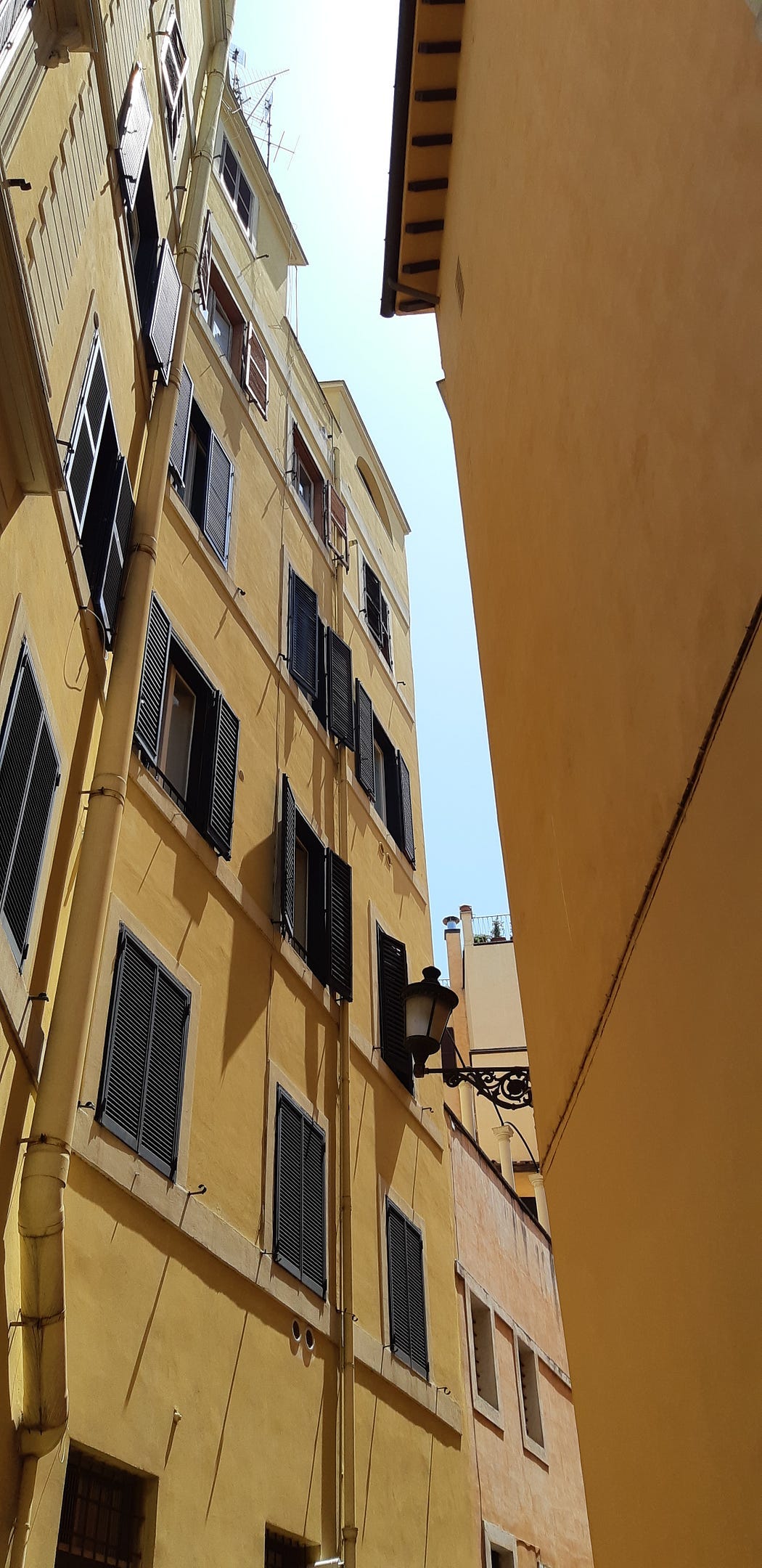
Unsurprisingly, the story swiftly descends into farce. The reader soon realises that the actual resolution of the two crimes on the Via Merulana has ceased to be the main subject of Gadda’s prose. Indeed, it becomes unclear whether the crimes will be solved at all. Instead, it is the city of Rome itself — its people, its rhythms, its sounds — that takes precedence in the narrative. The investigations of Ingravallo and his subordinates become little more than a path for the reader to explore the city further, each new lead revealing a whole new world of characters and their stories. As Calvino explains, the book demonstrates Gadda’s view of the world as a ‘system of systems’, each interlocking and overlapping in an entangled muddle of human relationships (indeed, the novel’s English title could just as easily refer to the community of the Via Merulana as it could to the actual crimes). It is into this jungle that we are led by Ingravallo’s inquiries, immersing ourselves deeper and deeper in the squalid underbelly of 1920s Rome as the book trundles on.
From a reader’s perspective, the novel is profoundly frustrating. Perhaps the original Italian text contains a greater sense of vernacular flow, but I find it hard to believe that Gadda’s chaotic writing style makes much more sense even before translation. It vaguely resembles a stream of consciousness — reviewers have compared Gadda to James Joyce — but the constantly changing cast of characters (Ingravallo himself is absent for a sizeable chunk of the narrative) marks a departure from more traditional modernist writing. Rather, it is the city of Rome whose consciousness is laid before us, acted out by a colourful array of characters scrabbling about in their grubby little social circles — their systems within systems.
To approach a novel like this, I soon learned, one must let go of any hope for a clean-cut, navigable story. This book is not familiar ground. Putting all preconceptions about detective novels aside (does it really matter if the crime is solved or not?), you are forced to immerse yourself fully in the chaos of Gadda’s prose. It is almost helpful to treat the novel less as a story and more as a case of ‘thick description’ — a deep, ethnographic dive into the interlocking social relationships that exist within the peculiar historical, cultural and spatial circumstances of 1920s Rome. Every hoarse policeman’s bark, every delivery boy’s childish jibe, every sex worker’s knowing smirk — each draws you unconsciously deeper into Gadda’s enthralling world. So strong is the pull of the writing that any mental guard you may have maintained comes down without you ever realising it. And so, by the end of the book, an intimate relationship has been established between the reader and the city itself.
For this reason, That Awful Mess was perfect for my experiment in immersive, place-based reading. Delving deep into Gadda’s text allowed me to understand the city around me in a more complex way. This wasn’t because I was spotting particular locations from the text — though at one point I did stumble out of a gloomy Irish bar onto (surprise!) the Via Merulana itself. It was more that reading the text as I explored the city and the surrounding countryside allowed me to encounter Rome — its streets, buildings, monuments and people — in a way that was more personally impactful. It was as though everything I encountered was somehow clearer, its colours more vibrant, its smells and sounds stronger. I felt able to really engage in the place around me, to shut off the constant alarm in my head that yelled ‘this is not a familiar place!’, because suddenly it was familiar. By forcing myself to delve into Gadda’s novel, I had been able to lower my barriers and establishing a personal connection with the physical place around me. And sure, the Rome of 2022 is not that of 1927, but it hardly matters. The two Romes became one, a dual city comprising of the same streets and same knackered old buildings, blending in the noise and ochre dust of summer. By opening myself up to the city — both on the page and in real life — I gained the confidence required to explore its depths.
The result was that I left Rome with a feeling of genuine connection. I won’t call this a spiritual journey, but my visit was nonetheless more meaningful because of the book I was reading. It was Gadda’s novel that had acted as the ‘gateway’ to my engaging with this new and vibrant place, forcing me to overcome my anxieties about engaging with the social and geographical complexities on the page and thus helping me do the same about the place around me.
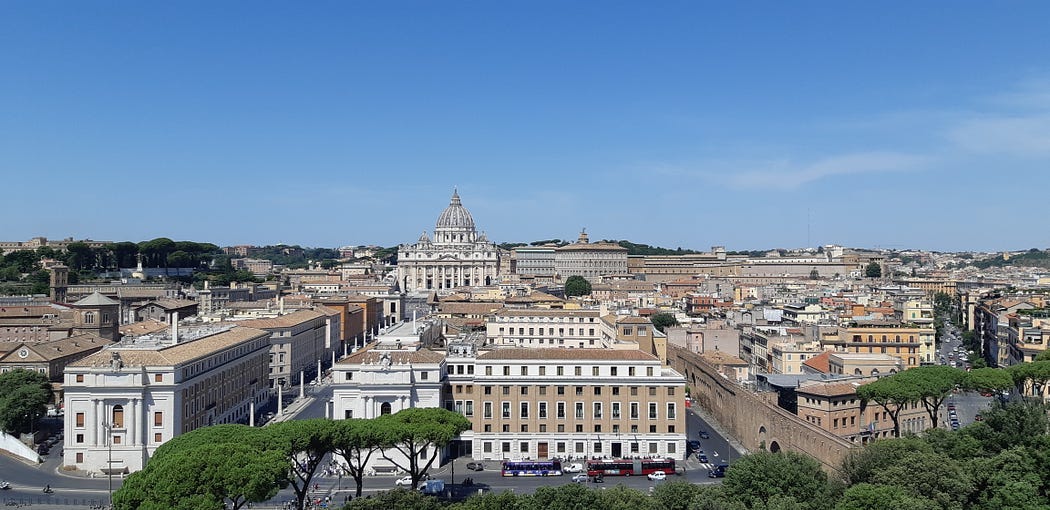
This article was intended as a review of That Awful Mess, and so I should end on some sort of judgement. There is much more I would have liked to have discussed, notably the novel’s satirising of the regime of ‘the Ass on high’ Mussolini, whom Gaddda skewers in increasingly creative language as the story goes on. But, for the sake of brevity I shall stick to my original aims. I set out to find a book that would help me immerse myself in Rome — to shut off from any thoughts and worries that existed beyond the city’s limits and commit myself entirely to its urban experience. Gadda’s writing gave me that.
Yes, it was a nightmare to read. I would almost call it inaccessible, but then I’m reminded of the poet Geoffrey Hill’s quip that accessibility is a perfectly suitable attribute for public toilets, but should never be forced upon works of art. But that isn’t the point. Gadda wrote with the aim of building up a complex web of places and personalities, and it is this quality that makes That Awful Mess the ideal book for immersive, space-based reading — especially for a reader who is anxious around uncertainty. By surrendering to the unfamiliar and letting myself be drawn into Gadda’s bizarre narrative, I was able to drift into the rhythms of the new, buzzing streets around me.
Even now, flicking back through its pages, I find myself back on the Via Merulana, slightly drunk in the fierce June sun, lost between the two cities.